

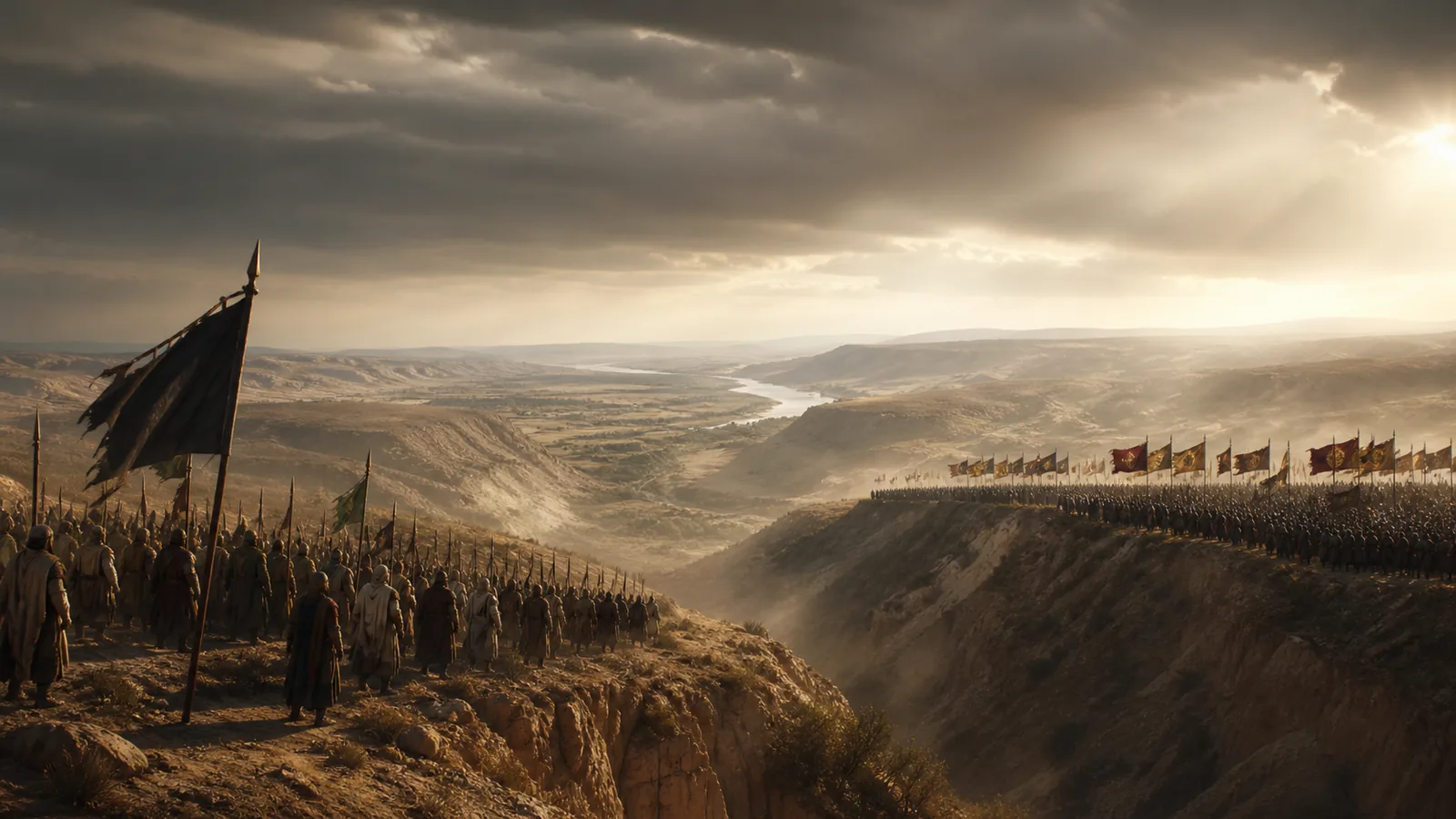
The Battle of Yarmuk took place in 636 CE, during Umar ibn al-Khattab’s caliphate. Abu Bakr had died in 634. This article remains part of the Abu Bakr series because it follows the consequences of the Syrian campaigns he began, but the battle itself must not be placed within his lifetime.
A major battle on the Syrian front
Yarmuk brought Muslim forces into a decisive confrontation with an Eastern Roman, or Byzantine, army. The outcome greatly weakened Byzantine control of Syria and helped establish the caliphate’s position in the region. It did not, however, end the Byzantine Empire.
That distinction matters when an account moves from battlefield success to imperial history. Losing a province is not the same as losing a capital or ceasing to exist. Later operations against Constantinople belong to other periods and should not be attached to Yarmuk as an immediate result.
What kind of evidence survives?
One accessible account is preserved by al-Baladhuri, a historian who died in the ninth century. Fordham’s Internet History Sourcebooks provides an English translation and dates the battle to 636. Al-Baladhuri was not an eyewitness; he collected reports about events more than two centuries earlier.
His narrative describes the defeat of the Byzantine army, pursuit of survivors and the emperor Heraclius’s departure from Antioch. It also supplies very large military totals and colourful details. Those elements should be identified as claims within the account, rather than presented as independently verified modern statistics.
Leadership without invented dialogue
Khalid ibn al-Walid and Abu Ubayda ibn al-Jarrah are central figures in Muslim accounts of the Syrian campaigns. Their military and leadership roles should be distinguished from later literary scenes that place elaborate speeches in their mouths.
A short overview cannot reconstruct every command decision. It can explain why coordination among forces mattered without claiming access to a complete battlefield transcript. Where narratives differ about arrangements or timing, acknowledging the difference is more useful than silently selecting the most dramatic version.
The people living in the region
Al-Baladhuri also relates an episode at Hims in which money was returned when Muslim forces could no longer guarantee protection before the confrontation. In his account, local people expressed support for their return. The story connects taxation with obligations towards a population.
It should not be expanded into a claim that every inhabitant of every conquered city welcomed every change of ruler. Regional history includes different communities, interests and experiences. One reported response cannot speak for them all.
Why Yarmuk belongs to the wider sequence
The early campaigns under Abu Bakr created a northern commitment that continued under Umar. Yarmuk demonstrates the scale that commitment eventually reached. It therefore connects the two caliphates while also showing why their dates must remain separate.
Its significance is substantial without inflated casualty ratios or claims of an instant imperial collapse. The most reliable outline follows the chronology, identifies the sources and keeps military events distinct from later religious and national memories. Readers can then explore fuller histories while knowing which details are secure and which require further comparison.
Sources and further reading
- Al-Baladhuri’s account of Yarmuk, Fordham Internet History Sourcebooks: a translated later historical narrative; the introduction provides the battle’s date.
- Oxford University Press, Secondary Islamiyat 7, chapter 2: Abu Bakr’s death, Umar’s succession and the transition between campaigns.
