

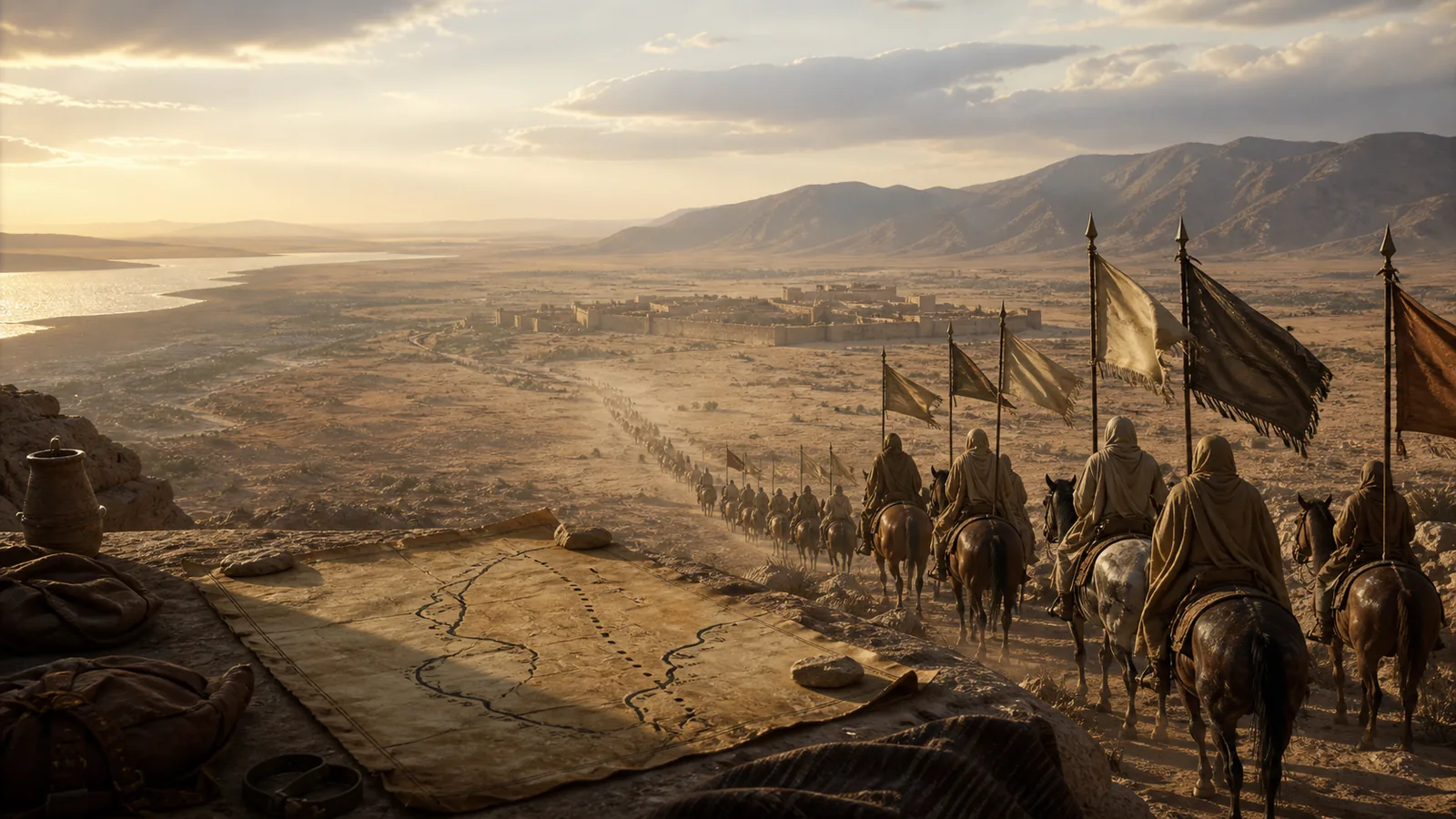
The campaigns in al-Sham opened a new northern front during Abu Bakr’s caliphate. They developed beyond the earlier expeditions of the Prophet’s lifetime and continued under Umar. Reading them in order helps distinguish the first advances from the later battles that changed control of the region.
Where was al-Sham?
Al-Sham is the historical name for the broader Levant, not just the modern state of Syria. In this account, the main imperial opponent was the Eastern Roman Empire, commonly called the Byzantine Empire. These are two names for the same empire, not two separate enemies.
The distinction is useful when following older translations, which move between “Roman,” “Byzantine” and “Syrian.” A reader should ask whether a passage describes an imperial army, a local community or the region itself. Those categories cannot simply be exchanged.
Earlier contact with the northern frontier
Mu’ta took place in 8 AH, followed by the expedition to Tabuk in 9 AH. Usama ibn Zayd’s northern mission followed in 11 AH, around the transition from the Prophet’s lifetime to Abu Bakr’s leadership. Keeping that order avoids placing one campaign before an event that had already occurred.
These episodes provided background, but they were not one continuous battle. Their aims, commanders and circumstances differed. In particular, Usama’s expedition should not be described as having already conquered the territory later entered by the caliphate’s armies.
The forces sent under Abu Bakr
The early Syrian campaigns involved commanders including Abu Ubayda ibn al-Jarrah, Amr ibn al-As, Yazid ibn Abi Sufyan and Shurahbil ibn Hasana. Their operations became connected with Khalid ibn al-Walid’s transfer from Iraq. The movement between fronts is an important link with the preceding article.
Yazid ibn Abi Sufyan should not be confused with the later caliph Yazid ibn Muawiya. Similar names can obscure the chronology when relationships and generations are left unexplained.
Accounts of Khalid’s desert crossing emphasise the demands of speed, water and coordination. The broad transfer is more secure than every dramatic detail attached to the journey. Exact travel times, reconstructed speeches and extraordinary survival stories need individual evidence before being repeated as fact.
Conduct towards people and property
Malik’s Muwatta preserves an account of Abu Bakr accompanying Yazid and giving instructions for the expedition. Among them are restrictions on killing women, children and elderly people, and on destroying fruit trees and inhabited places. The narration also discusses religious recluses and contains additional wartime commands.
This is a transmitted historical report, not a surviving recording of a speech. Its parts require context; selecting only a few lines does not settle every question about warfare. It certainly does not authorise private violence or hostility towards modern religious communities.
From early advances to later outcomes
The campaigns included the confrontation at Ajnadayn in 634. Further conquests continued after Abu Bakr’s death, while Yarmuk belongs to 636 under Umar. The beginnings of a policy and all its eventual outcomes should not be assigned to a single ruler.
For readers, the essential sequence is therefore straightforward: earlier northern expeditions, larger forces sent under Abu Bakr, coordination between the Iraqi and Syrian fronts, and later consolidation under Umar. That framework makes the next article on Yarmuk easier to follow without turning uncertain figures or modern political claims into historical evidence.
Sources and further reading
- Oxford University Press, Secondary Islamiyat 7, chapter 2: an introductory account of the commanders and campaigns.
- Muwatta Malik, Book 21, report 10: instructions to Yazid.
- TDV Encyclopaedia of Islam: Usama ibn Zayd (Turkish): the earlier mission.
- Al-Baladhuri’s account of Yarmuk, Fordham Internet History Sourcebooks: the later battle, with editorial dating.
