
Close Menu
  • Home
  • Islamic History
    • Life of Prophet Muhammad
    • Abu Bakr al-Siddiq
    • Umar ibn al-Khattab
  • Companions
  • Series
    • 40,000 Years of Knowledge
    • The Secrets of the Universe
    • Amazon Series
  • About
  • Contact
  • Series Reading Guide
What's Hot

Ibrahim and Nimrod in Islam: What the Quran Says—and What History Cannot Confirm

2 October 2026

Prophet Ibrahim and Ancient Mesopotamia: Quran, Sumer and the Limits of History

30 September 2026

Thamud and Prophet Salih: The Quranic Account and the Archaeology of al-Hijr

28 September 2026
YouTube
YouTube Facebook
Religion Essence Hub
  • Home
  • Islamic History
    • Life of Prophet Muhammad
    • Abu Bakr al-Siddiq
    • Umar ibn al-Khattab
  • Companions
  • Series
    • 40,000 Years of Knowledge
    • The Secrets of the Universe
    • Amazon Series
  • About
  • Contact
  • Series Reading Guide
Religion Essence Hub
Home » Episode 10 – As-Siddiq – Usama’s army and the War of Apostasy
Abu Bakr al-Siddiq

Episode 10 – As-Siddiq – Usama’s army and the War of Apostasy

Religion Essence Hub Editorial TeamBy Religion Essence Hub Editorial Team28 July 2025Updated:9 September 2026No Comments4 Mins Read3 Views
Facebook Twitter Pinterest Telegram LinkedIn Tumblr Copy Link Email
Follow Us
Google News Flipboard
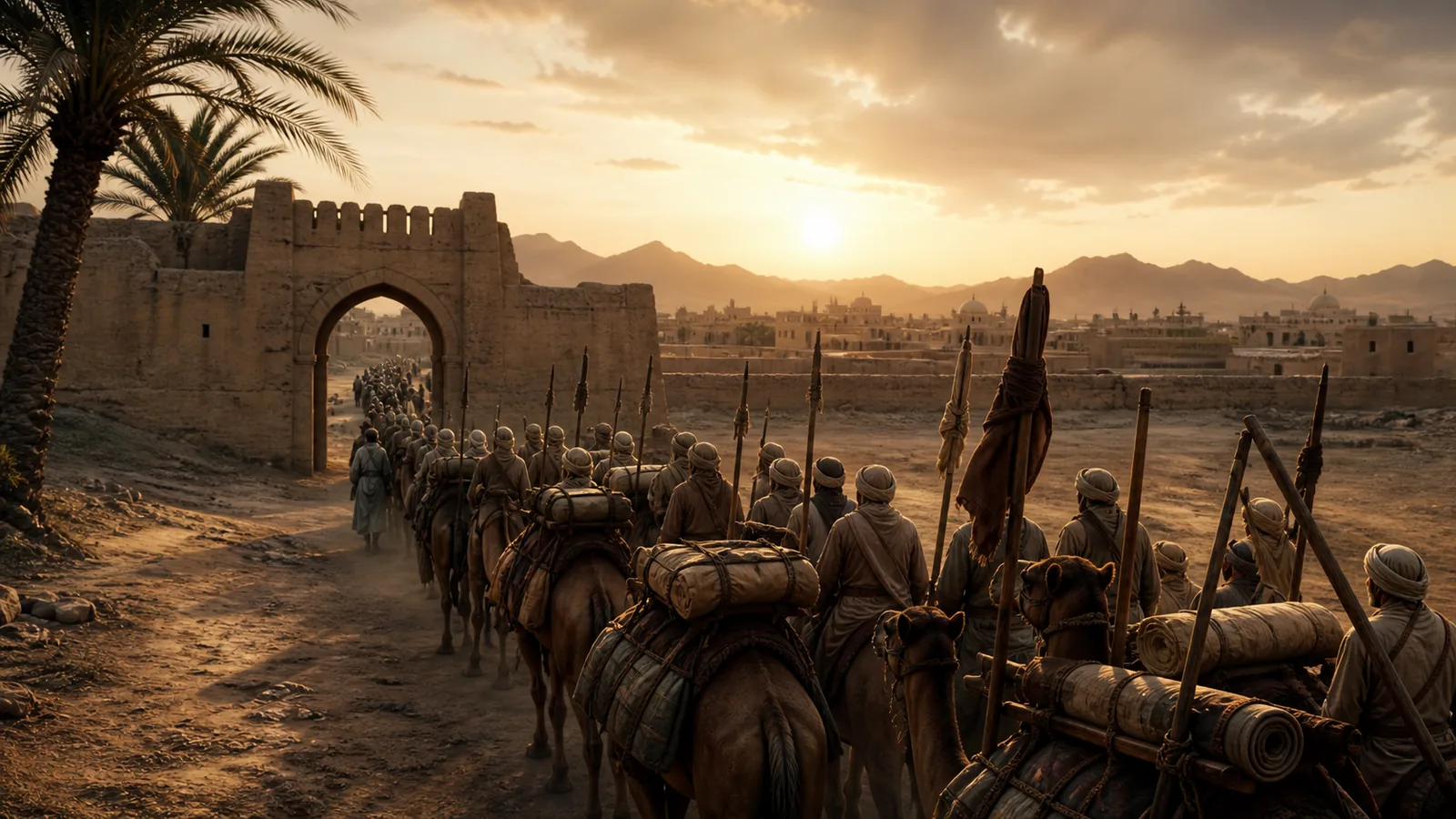
Army column preparing to depart Medina under Usama
Share
Facebook Twitter LinkedIn Pinterest Email Copy Link

Usama ibn Zayd’s expedition and the Ridda conflicts were two early challenges of Abu Bakr’s caliphate. One involved carrying forward a mission arranged by the Prophet Muhammad. The other concerned the survival of Medina’s authority after his death in 632 CE. They overlapped, but they were not the same campaign.

Why Usama had been appointed

Usama was the son of Zayd ibn Haritha, who had died commanding the Muslim force at Mu’ta. The Prophet appointed Usama to lead a northern expedition in the final period of his life. Preparations were interrupted by the Prophet’s illness and death.

Sahih al-Bukhari 3730 preserves the Prophet’s response to criticism of Usama’s appointment. He recalled similar objections to Zayd and defended both men’s fitness for command. The report makes trust and ability central to the appointment; Usama’s youth did not, by itself, disqualify him.

Abu Bakr continued the mission

Historical accounts describe concern about sending troops away while Medina faced unrest. Abu Bakr nevertheless retained Usama and allowed the expedition to proceed. The TDV Encyclopaedia of Islam’s biography places the mission in 11 AH, or 632 CE, and describes a raid into the Balqa region followed by a return to Medina.

This was a limited expedition, not the conquest of the Byzantine Empire. It did not capture Constantinople or cause the emperor to abandon his capital. Keeping that distinction clear also prevents confusion with the much larger campaigns in Syria during the following years.

The decision illustrates a real leadership problem: whether a new ruler should maintain an existing commitment when circumstances have become more dangerous. Abu Bakr’s choice is understandable as continuity with the Prophet’s instruction. That interpretation does not require invented troop totals or speeches presented as verbatim records.

What the Ridda conflicts involved

The term Ridda is used for conflicts following the Prophet’s death. The opposition was not uniform. It included rival religious leaders, rejection of Medina’s authority and disputes over the payment of zakat. Treating every group as having the same beliefs or motives hides the political as well as religious dimensions.

Bukhari 1399–1400 records Umar initially questioning Abu Bakr’s decision to fight people who professed Islam. Abu Bakr insisted that prayer and the obligation of zakat could not be separated. Umar then accepted his reasoning. The report preserves an argument between the two men, not an absence of consultation.

Instructions to commanders need context

A well-known report in Malik’s Muwatta attributes instructions about restraint to Abu Bakr when he accompanied Yazid ibn Abi Sufyan towards Syria. It includes protection for women, children and elderly people, and restrictions on destroying productive trees and inhabited places. This particular narration names Yazid, not Usama.

The report also contains other wartime commands that require historical and legal interpretation. It should not be repackaged as permission for present-day individuals to target people by appearance, religion or political disagreement.

The significance of the first decisions

These events show how closely military decisions, public obligations and leadership were connected in the early caliphate. The northern expedition demonstrated continuity, while the Ridda campaigns addressed challenges within Arabia. Neither episode supplies a shortcut for judging the faith or loyalty of people living today.

Sources and further reading

  • Bukhari 3730: Usama’s appointment.
  • Mehmet Salih Arı, TDV Encyclopaedia of Islam: Usama ibn Zayd (Turkish): the expedition and its setting.
  • Bukhari 1399–1400: Abu Bakr and Umar’s discussion of zakat.
  • Muwatta Malik, Book 21, report 10: instructions addressed to Yazid.

Continue the series

← PreviousAll partsNext →

Blog
Follow on Google News Follow on Flipboard
Share. Facebook Twitter Pinterest LinkedIn Telegram Email Copy Link
Religion Essence Hub logo
Religion Essence Hub Editorial Team
  • Website

The Religion Essence Hub Editorial Team researches, reviews and updates articles about religion, history, beliefs and culture.

Related Posts

Episode 10 – Al-Faruq Life of Non-Muslims under Umar

5 August 2025

Episode 9 – Umar ibn al-Khattab Becomes Caliph

5 August 2025

Episode 8 – Umar During Abu Bakr’s Caliphate

5 August 2025

Comments are closed.

Top Posts

Part 2 – Shepherding as a Metaphor for Prophethood

19 August 202446 Views

Part 4 – Hanifs: Monotheism in Pre-Islamic Arabia

19 August 202436 Views

Part 6 – The First Revelation in the Cave of Hira

4 September 202429 Views

Part 3 – Prophet Muhammad’s Marriage to Khadijah: Partnership, Sources and Context

19 August 202424 Views
Don't Miss
40,000 Years of Knowledge

Ibrahim and Nimrod in Islam: What the Quran Says—and What History Cannot Confirm

2 October 20268 Mins Read1 Views

The Quranic debate between Ibrahim and an unnamed ruler, the later identification with Nimrod, and why claims connecting him to Sargon of Akkad remain unproven.

Prophet Ibrahim and Ancient Mesopotamia: Quran, Sumer and the Limits of History

30 September 2026

Thamud and Prophet Salih: The Quranic Account and the Archaeology of al-Hijr

28 September 2026

Aad, Iram and Prophet Hud: What the Quran and Archaeology Show

25 September 2026
About Religion Essence Hub

Religion Essence Hub publishes accessible articles about religion, history, beliefs, scripture and culture. We explain complex topics clearly and responsibly. Email: contact@religionessencehub.com

Facebook YouTube
Our Picks

Ibrahim and Nimrod in Islam: What the Quran Says—and What History Cannot Confirm

2 October 2026

Prophet Ibrahim and Ancient Mesopotamia: Quran, Sumer and the Limits of History

30 September 2026

Thamud and Prophet Salih: The Quranic Account and the Archaeology of al-Hijr

28 September 2026
Most Popular

Prophet Ibrahim and Ancient Mesopotamia: Quran, Sumer and the Limits of History

30 September 20261 Views

Ibrahim and Nimrod in Islam: What the Quran Says—and What History Cannot Confirm

2 October 20261 Views

Part 38 – Madinah’s Jewish Communities and Early Political Tensions

19 February 20252 Views
  • Home
  • Privacy Policy
  • About Us
  • Corrections Policy
  • Disclaimer
  • Editorial Policy
  • Editorial Team
  • Get In Touch
  • Terms of Use
  • Cookie Policy (UK)
© 2026 Religion Essence Hub. All rights reserved.

Type above and press Enter to search. Press Esc to cancel.

Manage Consent
To provide the best experiences, we use technologies like cookies to store and/or access device information. Consenting to these technologies will allow us to process data such as browsing behavior or unique IDs on this site. Not consenting or withdrawing consent, may adversely affect certain features and functions.
Functional Always active
The technical storage or access is strictly necessary for the legitimate purpose of enabling the use of a specific service explicitly requested by the subscriber or user, or for the sole purpose of carrying out the transmission of a communication over an electronic communications network.
Preferences
The technical storage or access is necessary for the legitimate purpose of storing preferences that are not requested by the subscriber or user.
Statistics
The technical storage or access that is used exclusively for statistical purposes. The technical storage or access that is used exclusively for anonymous statistical purposes. Without a subpoena, voluntary compliance on the part of your Internet Service Provider, or additional records from a third party, information stored or retrieved for this purpose alone cannot usually be used to identify you.
Marketing
The technical storage or access is required to create user profiles to send advertising, or to track the user on a website or across several websites for similar marketing purposes.
  • Manage options
  • Manage services
  • Manage {vendor_count} vendors
  • Read more about these purposes
View preferences
  • {title}
  • {title}
  • {title}