

The fall of Babylon and the story of Yunus appear, at first, to belong to different worlds. One concerns empires, deportation and the rebuilding of a city. The other concerns a prophet, a voyage and a prayer made in darkness. Both raise a question that runs through religious history: what does deliverance mean when ordinary routes of escape seem closed?
This chapter follows those themes through Cyrus, Daniel, the unnamed traveller in the Quran and Yunus. It distinguishes archaeological evidence from biblical narrative, Quranic teaching and later Muslim reports. These sources can be read alongside one another, but they should not be merged into a single, supposedly verified chronology.
From Babylonian exile to Persian rule
Nebuchadnezzar II’s campaigns against Jerusalem brought destruction and deportation. The displacement was not simply a change of address: families lost access to their land, political institutions and a central place of worship. Different deportations occurred at different times, so a single rounded number should not be treated as an exact census of everyone taken to Babylon.
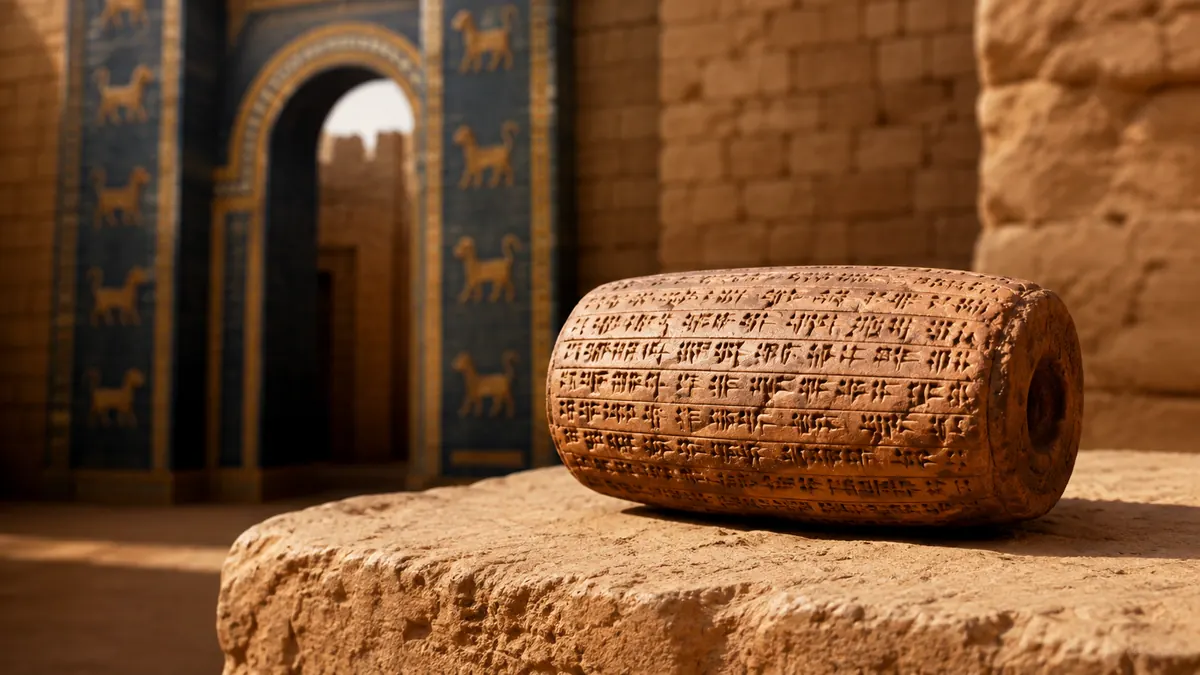
In 539 BCE, Cyrus of Persia captured Babylon. This is a securely documented historical turning point, unlike many colourful details attached to his life. The British Museum’s Cyrus Cylinder records his conquest and his claims to have restored shrines and returned displaced people and their cult objects. It is a royal inscription presenting the new ruler favourably, not a neutral report or a modern declaration of equal rights.
The biblical book of Ezra connects Cyrus with permission to return and rebuild the temple in Jerusalem. The cylinder provides a wider setting for restoration policies, but it does not name Jerusalem or independently prove every detail in Ezra. This distinction matters: an object can illuminate a historical background without verifying an entire religious narrative. See Ezra 1 and the Metropolitan Museum’s overview of Cyrus and ancient Persia.
Daniel: identify the source before joining the stories
Daniel, often called Daniyal in Muslim literature, is not named in the Quran. Stories about him come from the biblical book of Daniel and later traditions, including reports transmitted by Muslim historians. Calling something a story about a prophet does not make every detail in it a Quranic statement.
Two famous biblical episodes are often accidentally combined. In Daniel 5–6, the writing on the wall belongs to Belshazzar’s feast, while the lions’ den appears under a ruler called Darius the Mede. It is therefore inaccurate to retell both as a single incident involving Nebuchadnezzar or simply attribute the order about the lions to Cyrus. How the book’s rulers relate to external historical records is a separate question.
Later Muslim accounts describe a body associated with Daniel being found at Tustar, a manuscript sent to Umar, and a burial deliberately concealed to prevent inappropriate practices around a grave. Other traditions identify different burial places. These are reports with their own transmission histories, not an archaeologically confirmed identification of Daniel’s remains. A story about a ring bearing lions likewise cannot establish the identity of a body or authenticate every version of the lions’ den narrative.
The useful lesson is methodological: keep the biblical account, Muslim historical reports and archaeological findings labelled. That approach allows readers to appreciate a tradition without claiming more certainty than its evidence supports.
Was Cyrus Dhul-Qarnayn?
Cyrus is one proposed identification of the ruler called Dhul-Qarnayn in Surah Al-Kahf. Other identifications have also been suggested. The Quran does not supply a name that settles the question, and the surviving inscriptions about Cyrus do not establish a match with every journey and event in the Quranic account.
Neither imperial titles nor a popular retelling of the lions’ den can resolve the issue by themselves. The responsible conclusion is that Cyrus’s conquest of Babylon is historical, while identifying him as Dhul-Qarnayn remains an interpretation. For the wider Quranic context, see our guide to Dhul-Qarnayn and Surah Al-Kahf.
The traveller who returned after a hundred years
Quran 2:259 describes a traveller passing a ruined settlement and wondering how God would restore it. The passage relates his death and revival after a hundred years, with his food, drink and donkey serving as signs. Its focus is God’s power to restore life.
The verse does not name the traveller or the settlement. Some commentators identify him as Uzayr and connect the ruined place with Jerusalem, but those identifications should remain explicitly attributed to commentary. The verse itself does not provide a detailed history of how biblical books were collected.
It would be especially misleading to turn this passage into a blanket claim that an entire people deliberately invented their scriptures from memory. Textual history requires evidence from manuscripts and scholarship. A theological disagreement is not a licence to make unsupported accusations about a religious community.

Yunus and the prayer in darkness
Yunus is explicitly named among the messengers in the Quran. Surah As-Saffat 37:139–148 describes a laden ship, the casting of lots, a fish swallowing him, and his eventual recovery. He is cast onto an open shore while unwell, and a plant grows over him. The passage also describes the people to whom he was sent and their belief.
In Surah Al-Anbiya 21:87–88, the account centres on his appeal to God, acknowledging God’s perfection and his own wrongdoing. God answers him and delivers him from distress. The emphasis is repentance and mercy, not a technique for controlling events.
A reader can take encouragement from this prayer without assuming that every difficulty will disappear on a chosen timetable. The story encourages humility and trust; it should not be turned into a promise that a particular formula guarantees a particular worldly outcome.
Can we identify the fish?
The Quran does not identify a modern species or state how many days Yunus remained inside it. Later reports differ. Attempts to choose a blue whale, sperm whale or shark by comparing mouth sizes therefore go beyond what the text establishes.
A large mouth does not prove an animal can swallow a person, and an account of someone briefly entering a whale’s mouth would not demonstrate survival inside its stomach. Nor can such an anecdote verify a prophetic miracle. These are different kinds of claim, and treating them as interchangeable creates confusion rather than stronger evidence.
For a believer, the narrative’s miraculous character does not depend on finding a modern biological mechanism. For a historical or scientific reader, the limits of available evidence should remain visible.
Reading the chapter as a whole
Cyrus’s conquest, Daniel’s traditions, the revived traveller and Yunus do not form one continuous sequence that can be dated from a single source. They offer different perspectives on loss, return and dependence on God. Keeping those perspectives distinct makes the chapter clearer, more respectful and more useful.
Use the Series Reading Guide to follow the published chapters in order. Historical illustrations are interpretive artwork, not documentary evidence.
