

Bermuda Triangle explanations often begin with familiar hazards: powerful currents, sudden storms and navigation errors. These are real phenomena. The harder question is whether a particular explanation fits a particular loss.
This second chapter of The Doors of Mysteries examines those proposed causes. It also considers a recurring objection: if a vessel was large, its crew experienced or the weather initially clear, could a natural accident still have happened? The answer requires more care than either a sweeping dismissal or a supernatural conclusion.
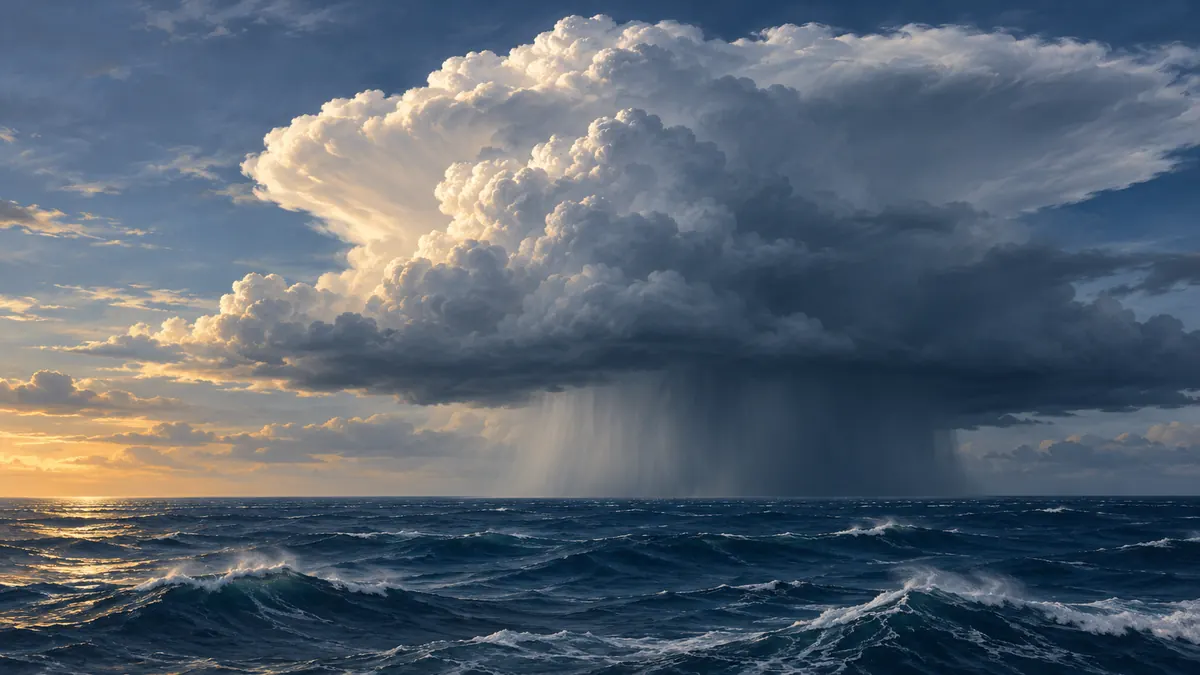
The featured storm image is AI-generated and does not depict a recorded accident.
A possible cause is not a completed investigation
There are three different claims to keep apart. A mechanism may exist in nature. It may be capable of harming a ship or aircraft. Finally, evidence may show that it occurred during the incident being discussed. Only the last step connects the general explanation to the specific case.
For example, knowing that storms occur at sea does not prove that a storm sank every missing ship. But failing to identify the exact storm does not prove that no natural accident occurred. Some historical records are too incomplete for a confident reconstruction.
NOAA’s Bermuda Triangle assessment points to environmental conditions and human factors rather than an established supernatural danger. That is a regional assessment, not a claim that investigators have solved every individual disappearance.
Could the Gulf Stream hide evidence?
The Gulf Stream is a strong ocean current that moves north past Florida before turning towards the northeast Atlantic. NOAA’s description of its flow explains why it is an important part of the region’s physical setting.
A moving current can carry floating material away from the position where a casualty occurred. This creates two separate questions: what caused the vessel to be lost, and where might debris subsequently travel? An answer to the second is not automatically an answer to the first.
The current should not be imagined as a single underwater force that swallows every ship in its path. Nor can it directly explain why an aircraft disappeared while still in the air. It may become relevant after an aircraft enters the sea, when investigators consider drift and search locations.
This distinction matters for cases such as USS Cyclops. Saying that currents might complicate a search does not establish how the ship sank, where it came to rest or whether particular debris existed. Those claims would require evidence from that voyage.
Does an experienced crew rule out an accident?
The episode contrasts inexperienced trainees with skilled sailors and pilots. The concern is understandable: describing a loss as “human error” without evidence can sound like blaming people who cannot respond. A responsible account should avoid that shortcut.
However, the reverse shortcut is also unreliable. Years of experience do not establish that navigation, communication, equipment or judgement could not have contributed. Conditions can become confusing even for trained people. Several problems may also interact during one emergency.
Flight 19 illustrates the need for precision. Its leader, Charles Taylor, had extensive flying experience; the other pilots were students with less experience. The Navy’s historical review describes radio exchanges suggesting navigational confusion, together with worsening weather and the risk of fuel exhaustion. The final cause remained unknown, and Taylor was cleared of blame.
Those findings do not justify a simple verdict against the pilots. They also do not support an account in which nothing was wrong until all five aircraft disappeared without warning.
Clear weather at departure is only one moment
A journey takes place over time and distance. A description of clear conditions at take-off cannot stand in for conditions along the whole route or at the last known position. That applies to a ship leaving harbour as much as to an aircraft leaving an airfield.
In Flight 19’s case, the Navy’s reconstruction describes conditions deteriorating during the afternoon and evening. It also treats the rescue aircraft’s probable fire as a separate loss. Combining both events into one unexplained weather-free disappearance removes information that investigators considered relevant.
Forecasts and warnings require similar care. The existence of a weather service does not mean that every crew received a precise warning for every location. To assess a historical event, we need the forecast available at that time, the observations along the route and what the crew actually knew.
Microbursts: sudden wind, not an “air bomb”
Some dramatic accounts call a violent downdraft an “air bomb.” That expression can obscure what is being proposed. A microburst is a small, intense descending column of air that spreads outward near the surface, producing dangerous changes in wind speed and direction.
The FAA’s guidance on weather hazards explains the downward and outward flows involved. This is a recognised atmospheric process. Its existence does not show that a microburst caused any unexplained loss selected from a list.
Pride of Baltimore: a storm casualty with survivors
The original Pride of Baltimore sank on 14 May 1986. The organisation’s history of the vessel attributes the loss to a microburst squall. Four people died and eight survived.
Survivor accounts make this a different kind of case from a vessel that never communicated again and left no known witnesses. It provides a reason to take sudden severe weather seriously. It does not establish the cause of unrelated disappearances decades earlier.
Concordia: the investigation did not confirm a microburst
The sail-training vessel Concordia capsized off Brazil on 17 February 2010. All 64 people aboard were rescued. It is sometimes presented alongside Pride of Baltimore as another proven microburst case, but the official finding is more specific.
Canada’s Transportation Safety Board investigation found no evidence that a microburst had struck. It considered horizontal winds of roughly 25–50 knots the most likely conditions during the squall. The vessel’s sail configuration, stability and water entering through unsecured openings were important to the capsize.
That correction changes the comparison. Two ships can both suffer severe weather without suffering the same weather phenomenon. Repeating an early dramatic description after an investigation has reached a different conclusion weakens the explanation rather than strengthening it.
What an abandoned ship does—and does not—tell us
An empty vessel can invite a striking question: if the ship survived, why did its people not remain aboard? Yet the condition in which a vessel is eventually found does not, by itself, reveal the choices or dangers facing the crew earlier.
The Carroll A. Deering is a useful example. It was found grounded on Diamond Shoals in 1921, with lifeboats missing and the crew gone. The National Park Service’s history does not describe a pristine, fully equipped vessel whose occupants disappeared in front of witnesses.
We should neither invent an evacuation sequence nor erase the evidence of an abandoned wreck. The unresolved question is what happened to the crew. Calling the vessel a “ghost ship” is a memorable label, not an explanation.
Why Alaska appears in the same discussion
The episode returns to Alaska because a failed search can feel as puzzling on land as at sea. Forest cover, mountainous terrain, snow and ice can make a search difficult. These are possible obstacles to discovery, not a licence to assign a particular missing aircraft to an unlocated crevasse.
The same caution applies to a missing traveller with local knowledge. Familiarity with a landscape is relevant, but it does not settle what happened. Nor does a large search team guarantee that the search covered the right place under conditions that allowed something to be seen.
Claims about unusually high numbers of disappearances need a defined population and period. Reports made over many years should not be treated as a count of people who remain missing. Without comparable figures, the size of a number cannot prove a geographical anomaly.
A better way to compare explanations
When reading a proposed explanation, look for a few concrete details:
- Identify the event: use a vessel or aircraft name, a date and a location.
- Check the conditions: distinguish the weather at departure from later observations.
- Follow the evidence: ask whether the claim comes from witnesses, an investigation or a later retelling.
- Separate stages: the cause of an accident and the reason wreckage was not found may be different.
- Keep uncertainty visible: a plausible mechanism is not a proven verdict.
Natural explanations become more useful when they are specific. Mysteries become more meaningful when their genuine gaps are preserved without adding unsupported details. That balance leaves room for curiosity while keeping the investigation tied to what the evidence can actually show.
Find the available chapters through the Series Reading Guide. The next chapter turns to unusual historical sky reports and the stories attached to abandoned settlements.
