

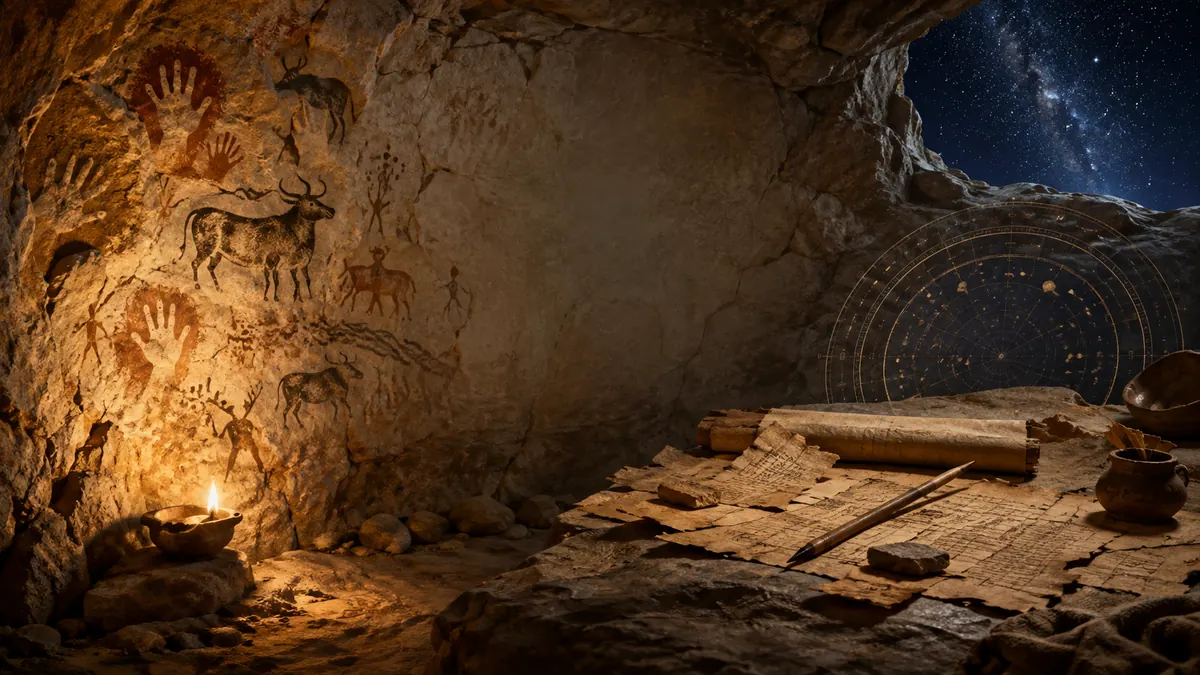
Prehistoric cave images, the Prophet Idris and the ancient Book of Enoch all invite questions about the earliest human communities. They are sometimes combined into one continuous story: early prophets taught writing and astronomy, cave images recorded their knowledge, and Enoch’s surviving book preserves the same revelation. The connections are intriguing, but the evidence does not support treating every step as established fact.
This article follows the themes of the source lecture while distinguishing four kinds of material: dated archaeology, explicit Quranic teaching, later Muslim tradition and ancient Jewish literature. That distinction is essential when discussing Idris and the Book of Enoch.
Cave art is older and more varied than once believed
For many years, European sites such as Chauvet and Lascaux dominated popular accounts of prehistoric art. Discoveries and improved dating in Indonesia have widened the picture.
A 2024 study dated a narrative scene from Leang Karampuang in Sulawesi to at least 51,200 years ago. The image appears to place human-like figures in relation to an animal, making it the oldest known securely dated representational narrative scene at the time of publication. The peer-reviewed Nature paper describes the dating method and interpretation.
Research published in 2025 pushed the minimum age of a hand stencil in Sulawesi to about 67,800 years. The Nature study used uranium-series dating of mineral deposits associated with the image. These dates may be revised as methods and samples improve, but they demonstrate that symbolic image-making was not a late European invention.
What cave images can reveal
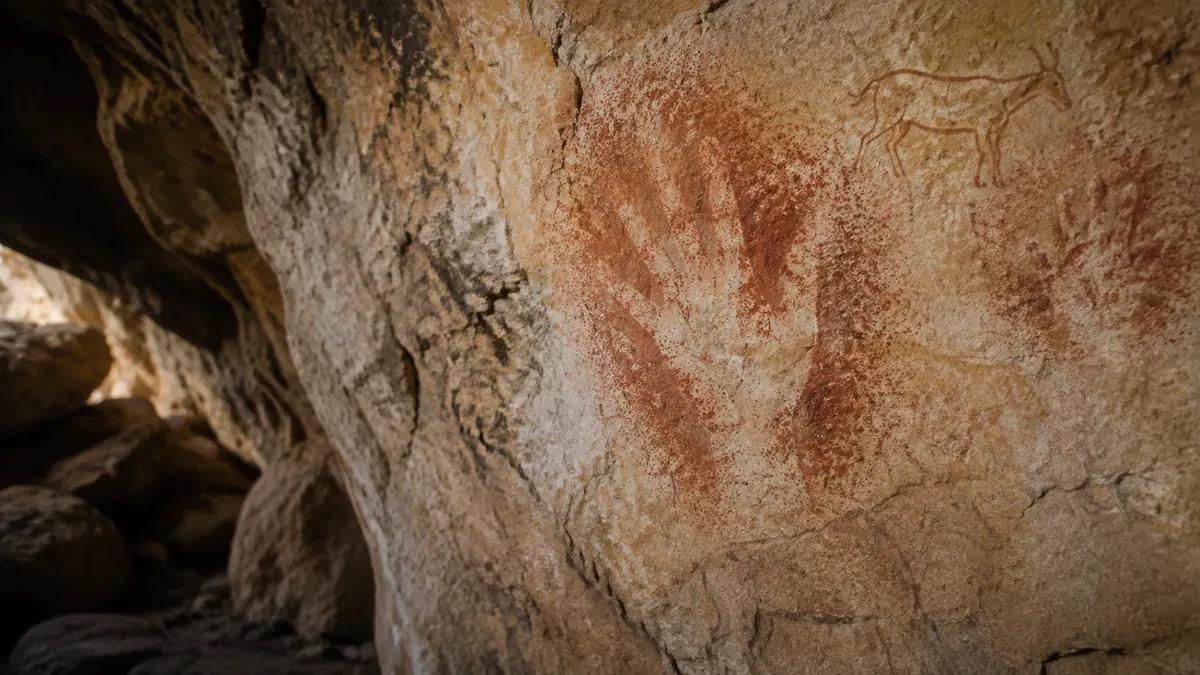
Cave and rock art can show that people observed animals, used pigments, selected meaningful spaces and sometimes arranged images into scenes. Hand stencils also create a direct visual trace of a person’s presence.
Researchers may compare the location of images, superimposed layers, associated tools and evidence of repeated visits. Yet meaning is harder to recover than age. The same image might relate to hunting, teaching, storytelling, identity, ritual or several purposes at once.
Terms such as “temple,” “religious ceremony” or “record of supernatural beings” require more evidence than the image alone. A figure that looks unusual to a modern viewer is not proof of an angel, jinn or extraterrestrial visitor. Responsible interpretation begins with what is visible and identifies symbolic readings as possibilities.
The Quranic Prophet Idris
Idris is one of the prophets explicitly named in the Quran. Quran 19:56–57 describes him as a man of truth and a prophet whom Allah raised to an elevated station. Quran 21:85–86 includes Idris among the patient and righteous people admitted to divine mercy.
Those verses are concise. They do not name his parents, date his life, identify a country, describe a writing system or give the title of a book revealed to him. Muslims can honour Idris without filling every silence with certainty.
Later Muslim historians and commentators transmit additional reports. Idris is sometimes associated with early writing, sewing, astronomy and calculation. Some writers identify him with Enoch, an ancestor of Noah in Biblical genealogy. These traditions influenced Islamic historical imagination, but they should be introduced as later reports rather than direct statements of the Quran.
Shees, or Seth, in later tradition
Shees is the Arabic form of Seth, a son of Adam in Biblical genealogy. Muslim historical works often describe him as righteous and sometimes prophetic. Some reports attribute revealed pages or early knowledge to him.
Shees is not named in the Quran. No Quranic verse links him to a cave painting, archaeological culture or surviving manuscript. The absence does not prove that every later report is false; it determines how confidently the report can be presented.
This is a recurring principle in early-history writing: a tradition may deserve respectful mention without becoming evidence for an archaeological identification.
What is the Book of Enoch?
“The Book of Enoch” usually refers to 1 Enoch, an ancient Jewish collection written and edited over time rather than a modern book by a single known author. It contains visions, angelic narratives, warnings of judgment, astronomical material and symbolic history.
The complete text survives in the classical Ethiopic language Ge‘ez through the Ethiopian Christian manuscript tradition. Much older Aramaic fragments were found among the Dead Sea Scrolls at Qumran. The Israel Antiquities Authority provides digital access to material such as 4QEnoch fragments.
These manuscripts establish that Enochic writings circulated in ancient Jewish communities before Islam. They do not prove that the surviving collection is an unchanged book written personally by the historical Enoch.
Is Enoch the same person as Idris?
The identification is traditional and possible within some genealogical schemes, but it is not explicitly made by the Quran. Similarities include Enoch’s position in pre-Noah genealogy and the description of being taken or raised by God in Biblical tradition, which readers compare with Idris being raised to a high station.
Similarity is not identity proof. Names move between languages, genealogies differ, and later communities may connect respected figures. A careful article can say that many Muslim writers associated Idris with Enoch while avoiding the stronger claim that the Quran confirms the equation.
The same caution applies to authorship. Even if the historical Enoch and Idris were the same person, it would not follow that every section of the surviving 1 Enoch collection is his unaltered revelation.
The 364-day calendar
Astronomical sections of Enochic literature describe a 364-day scheme. Related calendar traditions also appear among the Dead Sea Scrolls. A 364-day year has exactly 52 weeks, which keeps annual festivals on consistent weekdays within the system.
However, the solar year is about 365.24 days. A calendar using 364 days requires a method of adjustment if it is to remain aligned with the seasons over long periods. Scholars debate how ancient communities understood or implemented such correction.
The calendar demonstrates sophisticated concern with sacred time and celestial order. It does not by itself establish prophetic authorship, nor does it prove that all ancient astronomical knowledge came from one person.
Were the Dead Sea Scrolls “the original Bible”?
The Dead Sea Scrolls are a library, not one book. They include copies of Biblical texts, community rules, prayers, commentaries and works outside later Biblical canons, including Enochic material. The manuscripts are invaluable because they show the diversity of Jewish writing in the centuries around the beginning of the Common Era.
Calling the collection “the original Bible” is inaccurate. Some scrolls preserve very early witnesses to books later included in the Hebrew Bible, but the Qumran caves also held many other works. Manuscripts can show how a text circulated; they do not automatically settle who first composed it.
Can cave paintings be linked to prophetic teaching?
The idea is imaginative, but current archaeology cannot establish it. A dated pigment layer provides a minimum age and cultural context. It does not preserve the name or religious biography of the artist.
Islamic belief holds that Allah sent guidance to human communities, including messengers not named in the Quran. Quran 40:78 says that some messengers were mentioned and others were not. That teaching leaves open a broad sacred history. It should not be turned into a claim that a particular anonymous painting was made by a named prophet unless evidence supports the connection.
The stronger reflection is general: early people were observant, creative and capable of symbolic communication. Their works challenge crude pictures of the past as mentally empty.
Reading ancient sources responsibly
When several traditions overlap, a four-step method helps:
- Begin with the source. Quote or link the relevant Quranic verse, manuscript or archaeological report.
- Name the evidence level. Distinguish revelation, authenticated report, later tradition and scholarly hypothesis.
- Avoid visual certainty. Modern illustrations of prophets or prehistoric rituals are not documentary evidence.
- Allow uncertainty. “We do not know” is often more accurate—and more respectful—than a dramatic claim.
This method does not drain wonder from ancient history. It makes wonder durable because it no longer depends on a claim that collapses under basic checking.
Frequently asked questions
Is Idris named in the Quran?
Yes. He is named in Quran 19:56–57 and 21:85–86 as a truthful prophet and one of the patient and righteous.
Is Shees named in the Quran?
No. Accounts of Shees come from later historical and religious traditions.
Does the Quran say Idris wrote the Book of Enoch?
No. Some later writers identify Idris with Enoch, but the Quran does not name the Book of Enoch or attribute it to Idris.
Are the Qumran Enoch fragments the complete book?
No. Aramaic fragments of several sections survive at Qumran. The complete form is preserved through later Ge‘ez manuscripts.
Do cave paintings prove an ancient religion?
They provide evidence of symbolic and representational behaviour. Specific religious meanings require cautious interpretation and usually remain uncertain.
What to remember
Cave art demonstrates that sophisticated image-making reaches far back into human history. The Quran securely identifies Idris as a truthful prophet, while most biographical detail comes from later tradition. The Book of Enoch is a significant ancient Jewish collection represented among the Dead Sea Scrolls, but neither its surviving form nor its authorship can simply be equated with a lost scripture of Idris. Keeping those conclusions separate produces a stronger, more credible account.
For the preceding discussion, read Habil and Qabil in the Quran: The First Murder, Burial and Archaeological Evidence.
