

Historical mysteries often begin with a surviving trace: a printed picture of strange objects in the sky, an empty settlement or a word carved into wood. The trace is real. What it proves is a separate question.
This third chapter of The Doors of Mysteries follows reports from Nuremberg and Basel, the stories surrounding Portlock in Alaska, and the abandoned English colony at Roanoke. Each raises a different problem. A printed report, an oral tradition and a clue left by departing settlers cannot all be read in the same way.
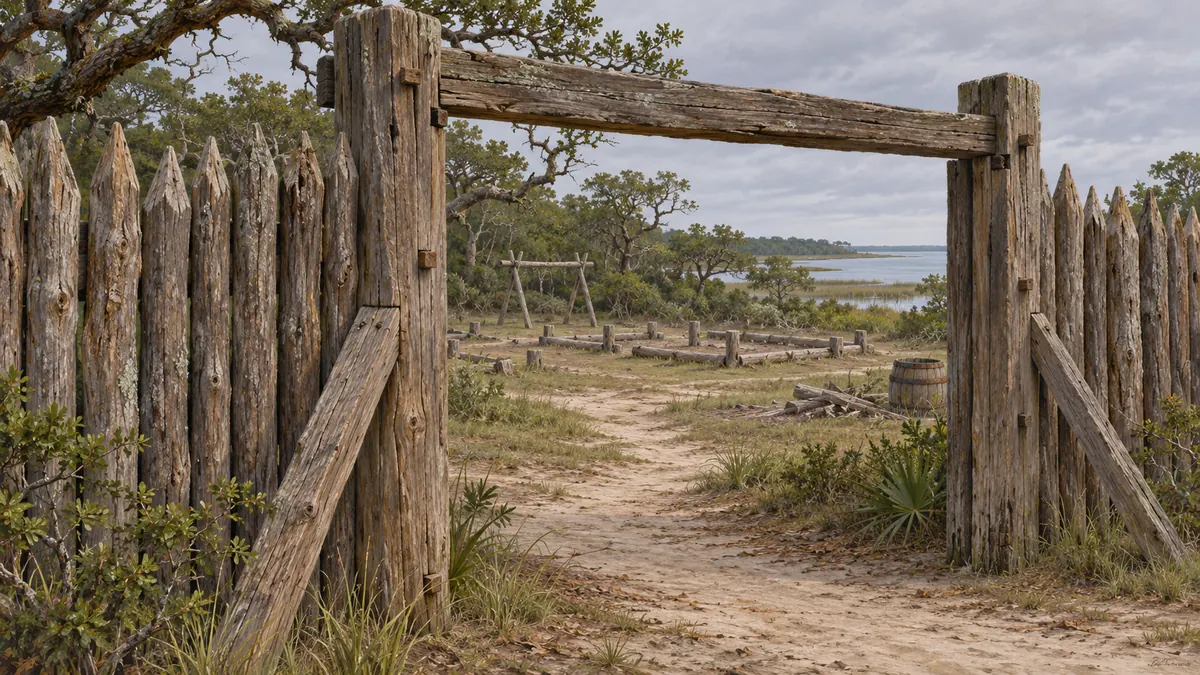
The featured image is an AI-generated reconstruction inspired by Roanoke. It is not an archival photograph or a view of surviving sixteenth-century buildings.
Nuremberg, 1561: what survives of the sky report?
On 14 April 1561, an unusual display was reported over Nuremberg, then a city of the Holy Roman Empire. A broadsheet associated with printer Hans Glaser described and pictured strange forms around the rising sun. The original print in the Zentralbibliothek Zürich collection survives in digitised form.
The account describes coloured spheres, crosses and tube-like shapes that seemed to move and fight. It also presents a dark spear-like form. These details explain why the print continues to attract attention: the scene appears much more elaborate than a passing light or a brief flash.
However, a surviving picture is not a photograph. It records how an event was represented by a printer and explained in text. The distinction is particularly important when modern readers see familiar technologies in shapes drawn centuries before those technologies existed.
A detailed description is still a description
The episode asks whether such detail could have been invented or misunderstood. It points to the number of reported observers and the apparent duration of the event. Those are reasonable matters to investigate, but they do not turn the print into a set of measurements.
A shape described as heavy does not establish its mass. A scene described as a battle does not prove that the forms were machines or living combatants. Likewise, a claim that many people watched is not the same as possessing separate, independently recorded statements from each of those people.
The library’s catalogue notes the print’s religious interpretation. That context belongs to the document itself. We can study how an alarming sight was understood as a divine sign without claiming either that a supernatural battle occurred or that every detail has a settled modern explanation.
Basel, 1566: three dates, one later narrative
A related broadsheet reports unusual appearances over Basel on 27 and 28 July and 7 August 1566. Its authorship is associated with Samuel Apiarius and Samuel Coccius. The Zürich library’s record of the Basel print identifies unusual sunrises and sunsets, dark spheres and an interpretation framed around divine warning.
The sequence matters. These were reports associated with several dates, not one uninterrupted event lasting ten days. The year is 1566, and the events belong to the sixteenth century. Keeping the chronology clear prevents errors from becoming part of the mystery.
The Swiss National Museum’s discussion adds an important limit: the two men who produced the leaflet did not witness the events themselves. They drew on first- and second-hand accounts. The museum places the leaflet within a period of religious anxiety and popular interest in signs in the sky.
What can we conclude about the cause?
The reports draw attention to the sun, its colour and the appearance of shapes around it. That makes atmospheric or astronomical conditions relevant lines of inquiry. It does not allow us to diagnose a particular eclipse, optical effect or other cause from a short description alone.
The museum discusses several proposed natural explanations while acknowledging that the exact cause remains uncertain. That uncertainty should stay visible. It would be misleading to present one suggestion as a confirmed solution, just as it would be misleading to treat the absence of a solution as proof of visiting spacecraft.
Nuremberg and Basel also illustrate how repetition can change a claim. A later writer may replace “the leaflet describes” with “hundreds of witnesses proved.” The second phrase sounds stronger, but it requires evidence beyond the existence of the leaflet.
Portlock: an abandoned settlement and a living legend
The episode next returns to Alaska. Earlier chapters discussed missing aircraft and the challenges of searching remote terrain. Portlock introduces a different subject: a community that people left, together with stories about why they left it.
Portlock was a cannery settlement on the southern Kenai Peninsula. Its folklore includes accounts of a large, hairy being commonly called Nantiinaq. Retellings connect the creature with frightening encounters, missing hunters and the community’s departure.
These accounts should be presented as accounts. The episode’s stories of attacks and deaths are not, on their own, verified incident records. Familiarity with local animals may be part of a storyteller’s explanation, but it cannot independently establish the identity of an alleged creature.
What the historical sources add
A 2024 Alaska Department of Labor history of ghost towns describes Portlock as a predominantly Alutiiq community. It distinguishes expanding lore from the limited official record and discusses economic reasons for departure. It dates the postmaster’s departure and the post office’s closure to 1950, rather than treating 1951 as certain.
The same account reports no official record supporting the widely repeated missing-person totals. A recorded death that later stories connected with the creature was classified as an accident. This does not mean every family memory can be resolved from a file. It does mean that a dramatic count of victims should not be published as established fact.
Local history also offers a practical explanation for movement between settlements. A research report incorporating testimony from Port Graham elders records Elenore McMullen’s account of people moving from Portlock to Nanwalek, Port Graham and Seldovia as cannery work changed. Its chronology does not align neatly with every other summary, so it should not be used to invent one exact departure night.
Leaving a place is not the same as vanishing
A community can become empty because its residents relocate. That is a different event from every resident disappearing without a known destination. In Portlock’s case, accounts of people moving to neighbouring communities are central to the history.
Folklore still matters. It can preserve fear, warnings, memories and ways of understanding a landscape. Respecting that role does not require treating every retelling as a literal, independently confirmed sequence of attacks. Nor should Alaska’s distinct Indigenous peoples be blended into one generic identity simply because a story takes place in the same state.
The careful conclusion is narrower than the legend: Portlock was abandoned, stories about Nantiinaq became associated with it, and the reasons families left cannot responsibly be reduced to a verified monster attack.
Roanoke: the clue that an “overnight disappearance” leaves out
The episode closes with Roanoke, in what is now North Carolina. This was an English colonial settlement, not a Spanish one. John White left in 1587 and did not return until 1590. That gap immediately limits the claim that an observer knew the whole community vanished in a single night.
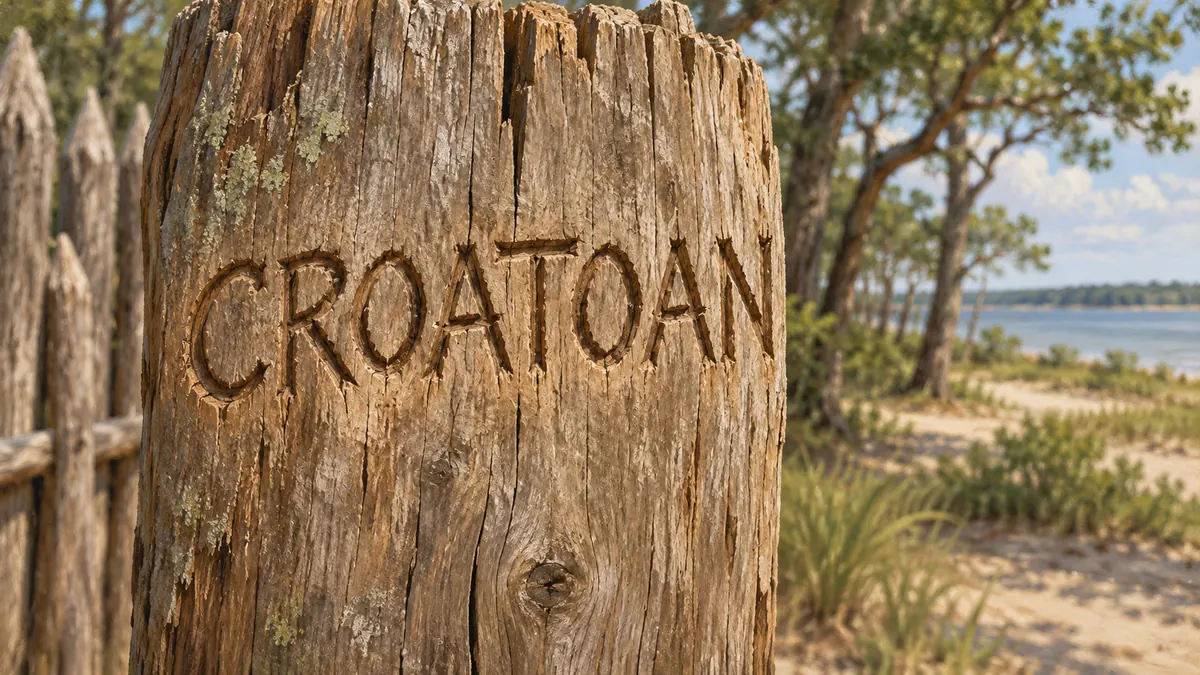
According to the National Park Service’s account of the return voyage, White found the settlement abandoned. He also found carved letters and the name CROATOAN. Storms and the difficulties of the expedition prevented him from following up the clue as he intended.
What did CROATOAN mean to John White?
In White’s account of the 1590 search, the settlers had agreed to leave a carved indication of their destination if they moved. They were also to add a cross if they left in distress. He reported the destination name without that distress sign.
White connected the clue with Croatoan, associated with people he knew, including Manteo. He also described buildings that had been taken down rather than simply left standing intact. His interpretation was that the colonists had moved, although he could not confirm where all of them ended up.
That evidence makes “they disappeared without leaving any clue” an inaccurate summary. There was a clue, and it had meaning within a prior arrangement. The unresolved issue is what happened after departure and whether all members of the community followed the same course.
Why the colony remains an open historical question
The National Park Service’s review of the major theories explains that no account has definitively established the fate of the entire colony. Possible relocation, food shortages, disease and conflict must be assessed against the evidence rather than combined into a single confident story.
The absence of bodies at the site does not prove that no violence ever affected any colonist. Equally, uncertainty does not justify accusing an Indigenous community of killing everyone. A responsible account should identify the evidence for a claim before turning it into a verdict about real people.
Why do these mysteries seem different from ordinary life?
The episode ends by asking why a modern visitor can enter a supposedly mysterious area and experience nothing unusual. The same question is raised about the old European sky reports: why is the dramatic scene not simply repeated for anyone who looks?
A rare event, a disputed report and a story that changes through retelling are different possibilities. None would be expected to recur on demand. An uneventful visit cannot settle a historical case, and a historical narrative cannot establish that a place must be dangerous on every visit.
The most productive questions are smaller. Which document survives? Who produced it? What did the writer observe directly? Which details appeared later? What would count as evidence against the preferred explanation?
Those questions preserve the interest of the stories while keeping their limits clear. Nuremberg and Basel leave us historical reports to interpret. Portlock leaves a settlement history intertwined with folklore. Roanoke leaves a destination clue whose full outcome remains unknown. Treating these as distinct problems is the first step towards understanding each one.
Continue through the available chapters using the Series Reading Guide.
